
WHOI — New study finds rate of U.S. coastal sea level rise doubled in the past century
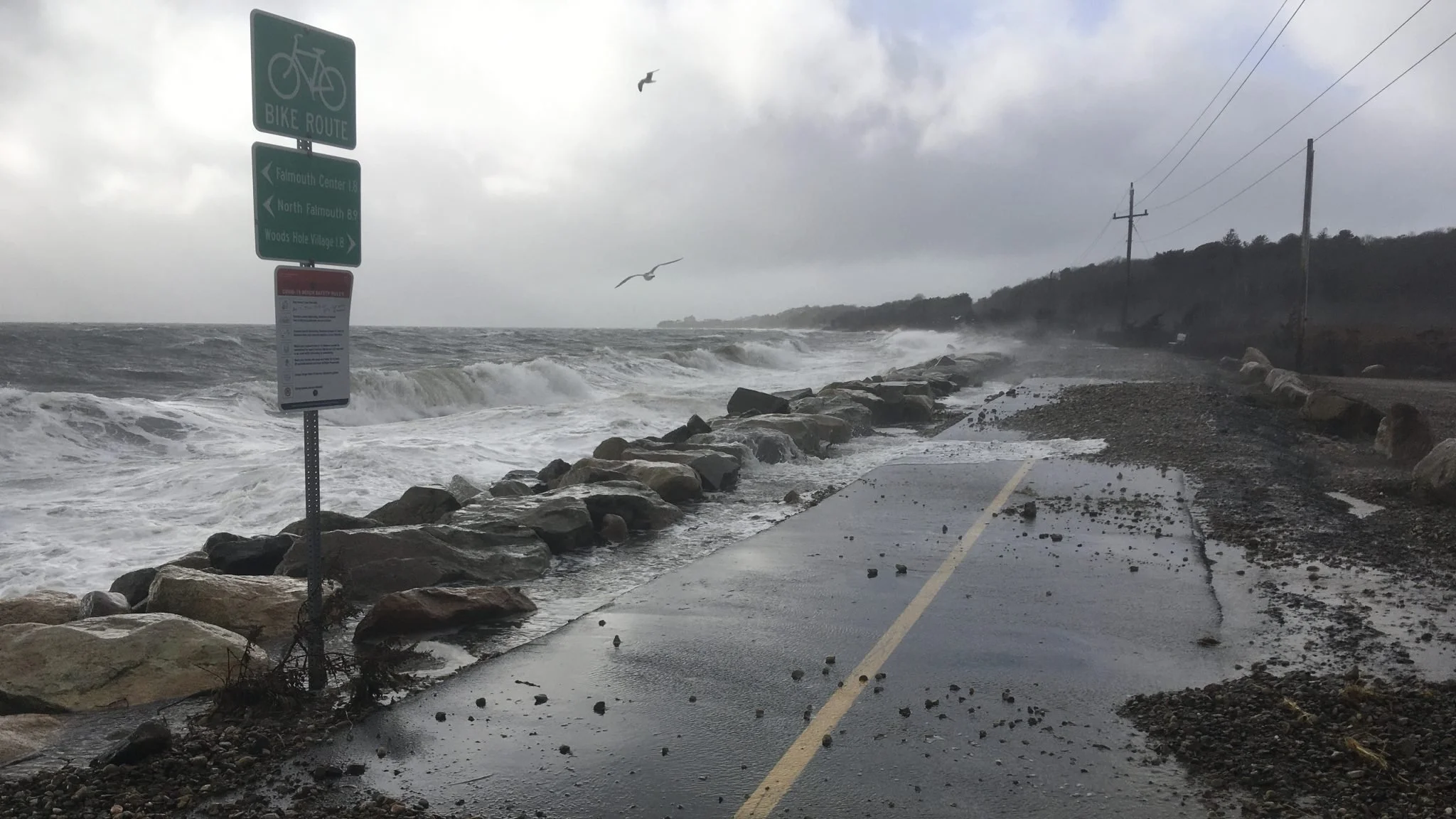
Impacts from flooding that occurred in Falmouth, Massachusetts on December 23, 2022. (Photo by Chris Piecuch)
December 17, 2025
By Woods Hole Oceanographic Institution -- A July 2025 report from the U.S. Department of Energy (DOE) claims that U.S. tide gauge measurements “in aggregate show no obvious acceleration in sea level rise beyond the historical average rate.”
However, a new study by Chris Piecuch, a physical oceanographer with the Woods Hole Oceanographic Institution (WHOI), reaches a dramatically different conclusion.
The study finds that the rate of U.S. coastal sea-level rise has more than doubled in the past 125 years, from a rate of less than 2 millimeters per year in 1900 to more than 4 millimeters per year in 2024, and that present rates are well above the historical average. This translates to a rise in U.S. coastal sea level of about 40 centimeters, or nearly 16 inches, over that time.
“This represents conclusive evidence that coastal sea level in the U.S. is accelerating, likely due to climate change,” according to the study, “The Rate of U.S. Coastal Sea-Level Rise Doubled in the Past Century,” published in the journal AGU Advances. Piecuch said the acceleration of U.S. coastal sea level is consistent with what is happening on a global scale related to ongoing ocean warming and expansion and to continuing loss of ice from glaciers and ice sheets.
The authors of the DOE report base their conclusion on analysis of data from five tide gauge records “that may be heavily impacted by local effects and not representative of true large scale aggregate RSL [relative sea level] behavior,” according to Piecuch’s study, which adds that the DOE report’s conclusions “should be treated with caution,” due to the small number of locations considered.
In contrast to the DOE report, the Piecuch study uses data from 70 tide gauges distributed along the contiguous U.S. coast. The data set comprises all active U.S. tide-gauge stations with more than 30 years of data.
…