
NY Times — An Ancient Law Could Shape the Modern Future of America’s Beaches. Here’s How.
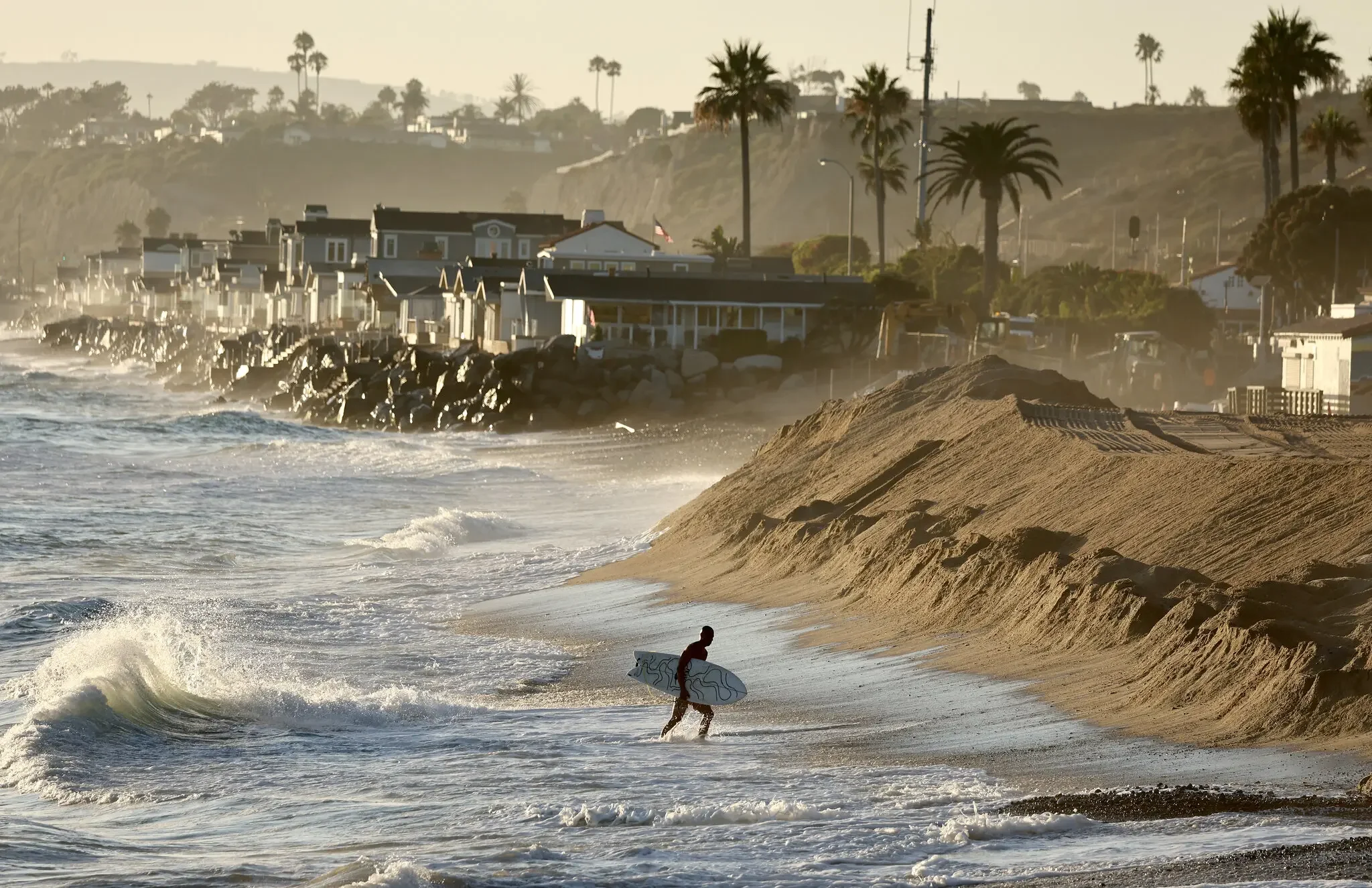
Coastal walls built to protect homes from the sea in San Clemente, Calif.Mario Tama/Getty Images
July 19, 2025
By Cornelia Dean
Cornelia Dean is a science writer and former science editor of The New York Times. She reported from Matunuck, R.I.
The growing battle over how to manage sea level rise turns partly on a legal principle set down in Roman times.
If you go to a beach this summer, you might end up sunbathing in disputed territory. That’s partly because of climate change and partly because of a legal principle from the Roman Empire.
Most beaches have a natural defense against rising seas: The sandy area simply moves landward. But when property owners install sea walls or other barriers to protect beachfront homes and other buildings, the beach has nowhere to go. So it vanishes underwater.
Geologists call it coastal squeeze. It’s not a new problem, but it’s been accelerating recently as climate change causes sea levels to rise. And that’s prompting urgent questions about how coastal landscapes should be managed.
Richard K. Norton, a professor in the urban and regional planning program at the University of Michigan, described the situation with a question: “Are you going to save the beach house, or do you want to save the beach?” he said at a recent conference in New York City organized by Columbia University. “Because you cannot save them both.”
At issue is a legal concept from the sixth century A.D., when Emperor Justinian ordered the codification of Roman laws. The resulting code declared that features of nature like the air, running water, the sea and “the shores of the sea” must be held in trust for the use of the public. That idea passed into English common law, and then to the United States.
Today, most states define the beach below the high-tide line as public trust property, meaning members of the public have free access.
…